
NCAA Rule Changes Summarized
The NCAA has issued new padding requirements for softball facilities and has highly recommended increased padding for baseball venues.
Softball
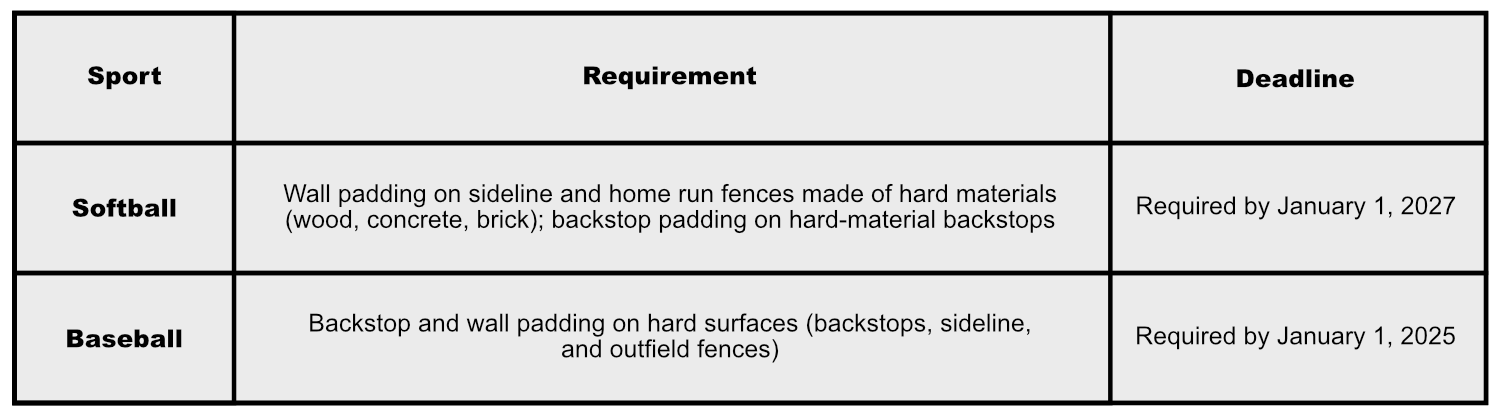
NCAA Rule 2.15 requires sideline and home run fences constructed of hard materials (wood, concrete, or brick) to be padded by January 1st, 2027. Padding must begin no higher than 1 foot off the ground and extend either to the top of the wall structure or up to 6 feet from the ground, whichever is shorter. Backstop padding is also required for backstops made of wood, concrete, or brick.
Read the NCAA Softball Rules Here
Baseball
As of 2024, the NCAA highly recommends baseball facilities install padding on all exposed hard surfaces — including backstops, sideline fences, and outfield fences — where a player could collide during play. You can now find this in NCAA Baseball Rule 1, Section 2, Subsection E.
Baseball is expected to follow the lead of softball with this wall padding requirement.
Read the NCAA Baseball Rules Here
Softball Rule 2.15: Sideline and Home Run Fence Padding
“By January 1, 2027, require sideline and home run fences constructed of a hard material (e.g., wood, concrete, or brick) to be padded. Padding must begin not higher than 1 foot off the ground and extend to the top of the wood, concrete, or brick, or 6 feet from the ground, whichever is shorter. This is required for any field hosting NCAA softball competition.”
Softball Rule 2.3.4: Backstops
“For institutional and municipal fields, when the backstop is wood, concrete or brick, it shall be padded from dugout to dugout beginning not higher than 1 foot off the ground and extending to the top of the wood, cement or brick or 6 feet from the ground, whichever is shorter.”
Baseball Rule Rule 1, Section 2, Subsection E: Infield, Outfield
“It is recommended that padding be placed on all hard surfaces (backstops, sideline and outfield fences) that a player is likely to collide with during play.”
Beyond this recommendation, the NCAA stated in 2022 that they expected padding to become a requirement by 2024 for Division I baseball, and by 2025 for Divisions II and III. That has yet to happen, but such a move seems all the more likely after the 2027 Softball rule change.
Dugouts: Baseball Rule 1-16, Softball Rule 2.13.2
There is a related new requirement: dugout fencing. Though full-field padding is still a recommendation, the following was added to the NCAA Baseball rule book in 2024 in section 1-16:
“Facilities for collegiate baseball shall have protective fencing or netting on the field side of the dugout at a height not less than three feet from the field level. It is required effective Jan. 1, 2024, for Division I and Jan. 1, 2025, for Divisions II and III.”
A similar rule is in the Softball rule book, Rule 2.13.2:
“It is recommended that dugouts are enclosed at each end and at the rear. For institutional and municipal fields, it is required that the field side of the dugout be protected by netting or fencing not less than 6 feet from the floor of the dugout except for the designated entrances and exits to the field.”
When you combine this with the sideline padding requirements/recommendations, it seems necessary to pad dugout fence rails.
Why the NCAA Added Padding Requirements
- Player-collision studies show that padded walls significantly reduce concussion and impact injury risk.
- Brings softball sideline and outfield fence requirements in line with the recent backstop padding requirement for hard-surface backstops.
- Reduces liability for schools and conferences.
- A one-time install with pads typically lasts 8–10 years under normal use.
Timeline for NCAA Padding Compliance
Which Stadium Areas Must Be Padded?
Outfield Wall Padding
Also known as stadium padding or home-run wall padding, this wall padding protects against full-speed leaps with 3-ft-wide panels that are mounted on Z-clips for quick removal during maintenance. If you’re looking for a way to increase school spirit, consider printing these pads with your teams branding and accomplishments, or, if you’re looking to make some extra revenue for your program, consider printing these pads with the logos of sponsors.
Sideline and Dugout Rail Padding
Sidelines take the brunt of foul-ball chases, so make sure your players aren’t taking the brunt of hard surfaces. Dugout rails are also particularly dangerous sections of the sideline, so make sure you give them extra care by ensuring corners and angles are padded and safe for players, coaches, and fans.
Backstop Padding
Padding is essential at the backstop, as catchers routinely crash into these walls. To absorb impact effectively, we recommend you use 18-oz vinyl stadium wall padding with 3-inch high-density foam.
For a detailed breakdown of padding thicknesses, mounting systems, and how to plan a full-field layout, check out our stadium and field padding guide below.
How To Choose The Right Padding
Best Installation Practices
1. Measure twice. Record exact rail diameters and wall heights.
2. Choose mounting hardware. Z-clips for concrete/brick, bolt-through kits for chain-link.
3. Allow for drainage. Leave a 1-inch gap at the turf line to prevent moisture wicking.
4. Off-season scheduling. Aim for late-summer or winter break to avoid game delays.
5. Inspect annually. Tighten anchors and wipe vinyl with mild soap to maximize pad life.
Protect your athletes, avoid penalties, and showcase school pride when you order your outdoor padding! Click the button below to get a free quote:
Valley Athletics’ Compliant Padding Lineup
Stadium Outfield Wall Padding
Built for outfield, home-run, and sideline fences, our panels pair 18-oz PVC-coated vinyl with 2-, 3-, or 4-inch AirTex foam and a ¾-inch AdvanTech® wood backer. Their Z-clip hardware makes installation fast, and the bottom vents shed moisture. Our padding is made to custom heights and widths to meet any ballpark specifications, and the fabric is formulated and coated to withstand UV, rot, and mildew for seasons of play. Full-digital printing is available so that you can brand your ballpark or sell sponsorship placements to fund your padding and make extra revenue for your program.
Backstop Padding
With backstop padding, you can reduce ricochet and protect your catchers with heavy-density foam that’s wrapped in 18-oz vinyl. Our backstop padding can be made either soft-backed with grommet holes to easily install onto chain link fencing, or hard-backed to install via z-clips onto brick or concrete backstops. Full-digital printing is available so that you can brand your ballpark or sell sponsorship placements to fund your padding and make extra revenue for your program.
Fence Top Padding
Style and safety are combined into one with our line of fence top padding! Its pre-slit, color-matched foam caps slide over chain-link rails up to 2″, shielding outfielders from sharp wire and giving the fence a pro finish with a highly visible home-run line. Making your field look great while keeping your players safe? Sounds like a win to us!
Premium Rail and Post Padding
Help protect players from impact with hard rail surfaces in NCAA baseball and softball settings by installing rail padding along your baseball facility dugout. Our 1″ or 2″ UV-treated foam cores are wrapped in 18-oz vinyl to protect dugout rails, on-deck circles, and bullpen posts. They’re durable enough for foul-ball impacts and vibrant enough to match team colors or sponsorship marks, so that you can increase school spirit or make extra revenue for your program.
Frequently Asked Questions
Does NCAA baseball require wall padding?
NCAA baseball has highly recommended increased padding on all hard surfaces, including backstops, sideline fences, and outfield fences, where a player may collide with a hard or sharp surface during play. It is expected to follow the lead of NCAA softball and be approved as a requirement for all divisions.
Does NCAA softball require wall padding?
Yes. NCAA softball requires wall padding on sideline and home run fences made of hard materials, including wood, concrete, and brick, beginning January 1, 2027.
What padding thickness meets NCAA requirements?
NCAA requirements do not state a minimum, but we recommend following the guidelines of relevant standards, like ASTM F2440-24 and having a minimum of 2″ on hard surfaces.