
Your players’ safety should be your number one priority, and with stadium and field padding, you can make sure they stay as safe as possible during practice and game time. Every rigid surface on a baseball or softball field that a player can collide with is a candidate for padding. Outfield walls, backstops, dugout rails, fence posts, and exposed columns are all contact points where a full-speed collision can cause serious injury. With the right padding absorbs that impact, reduces concussion risk, and gives players the confidence to play aggressively at the boundaries of the field, you can make sure that your players’ safety isn’t jeopardized.
The types of outdoor wall padding and fence padding used on athletic fields, where each type belongs, how to choose the right thickness and mounting system, and what to consider when planning a facility-wide padding layout can be overwhelming, but this guide covers all of that for you. NCAA programs are now facing the Rule 2.15 compliance deadline, our dedicated NCAA padding requirements guide covers the specific rule text, enforcement timeline, ASTM foam specifications, and a step-by-step compliance checklist has got you covered and ready to not only be safe, but compliant with the rules.
For field dimensions that affect your padding layout, see our Baseball Field Dimensions Guide.

Where Your Field Needs Padding
The type of padding, thickness, and mounting method depend on where the surface sits relative to the playing field and how likely players are to make contact with it at speed. Not every fence or wall needs the same treatment.
Outfield Walls and Home Run Fences
This is the most dangerous and highest-impact zone on any baseball or softball field. When outfielders track fly balls at full sprint, they often reach the warning track with little time to slow down before the wall. Our stadium padding on outfield walls is available in 2-inch, 3-inch, and 4-inch foam thicknesses, each wrapped in 18 oz. PVC-coated polyester that resists rot, mildew, and UV degradation. A 3-inch pad is the most common choice for outfield walls at the high school and college level, while professional facilities often use 4-inch padding for maximum impact absorption. Every Valley Athletics outfield pad is backed with 0.75-inch AdvanTech enhanced wood that outperforms standard OSB and plywood in moisture resistance and structural rigidity. The padding holds up through years of outdoor exposure with its bottom moisture vents that allow condensation to escape and prevent mold buildup from the inside.
Backstops
Sitting directly behind home plate, the backstop is typically 25 to 60 feet back depending on the level of play. Foul tips, wild pitches, and passed balls constantly hit the structure, and catchers or base runners often make contact during play. If possible, backstop padding should cover the full width of the backstop from dugout to dugout. At the NCAA level, 3-inch padding is required on any backstop made of wood, concrete, or brick. Softball fields especially benefit from padding due to the shorter distance between home plate and the backstop, which increases the frequency and force of impacts. You can find our selection of backstop padding here.
Fence Rails and Posts
Built on metal pipe rails and vertical posts that create hard contact points around the field’s entire perimeter, chain-link fences are definitely something that can cause injury. Our custom fence rail and post padding cushions these rigid components with foam that softens impact and covers exposed metal edges that can cause severe injuries. This is one of the most common yet most overlooked forms of baseball fence padding. Giving the illusion of a soft surface, the chain-link mesh may appear safe, but the rails behind it are not. To fit standard round or square pipe diameters, our rail pads come pre-slit and attach with bolt-through hardware for a secure, gap-free fit.
Dugout Openings and Sideline Structures
Along the edges of dugout openings, concrete retaining walls, stairwells leading to the stands, bullpen gates, and any exposed columns or railings near the field of play, padding should be installed. Players chasing foul balls, sliding into foul territory, or overrunning first base can still make sudden contact with them, even if these areas aren’t high-speed collision zones like outfield walls. Providing a reliable layer of protection without adding bulk, standard 2-inch padding is typically adequate for these structures.
Fence Tops
The top edge of a chain-link fence is one of the most hazardous surfaces on the field, as exposed twisted wire can easily cut or scrape skin. Our fence top padding or fence top cap protection covers this edge with a smooth, cushioned surface that helps prevent injuries to players reaching over or colliding with the fence.
Choosing the Right Padding Thickness
Padding thickness should match the speed of contact expected at each location. The higher the impact speed, the thicker the foam needs to be to absorb the energy before the player’s body reaches the hard surface behind it.
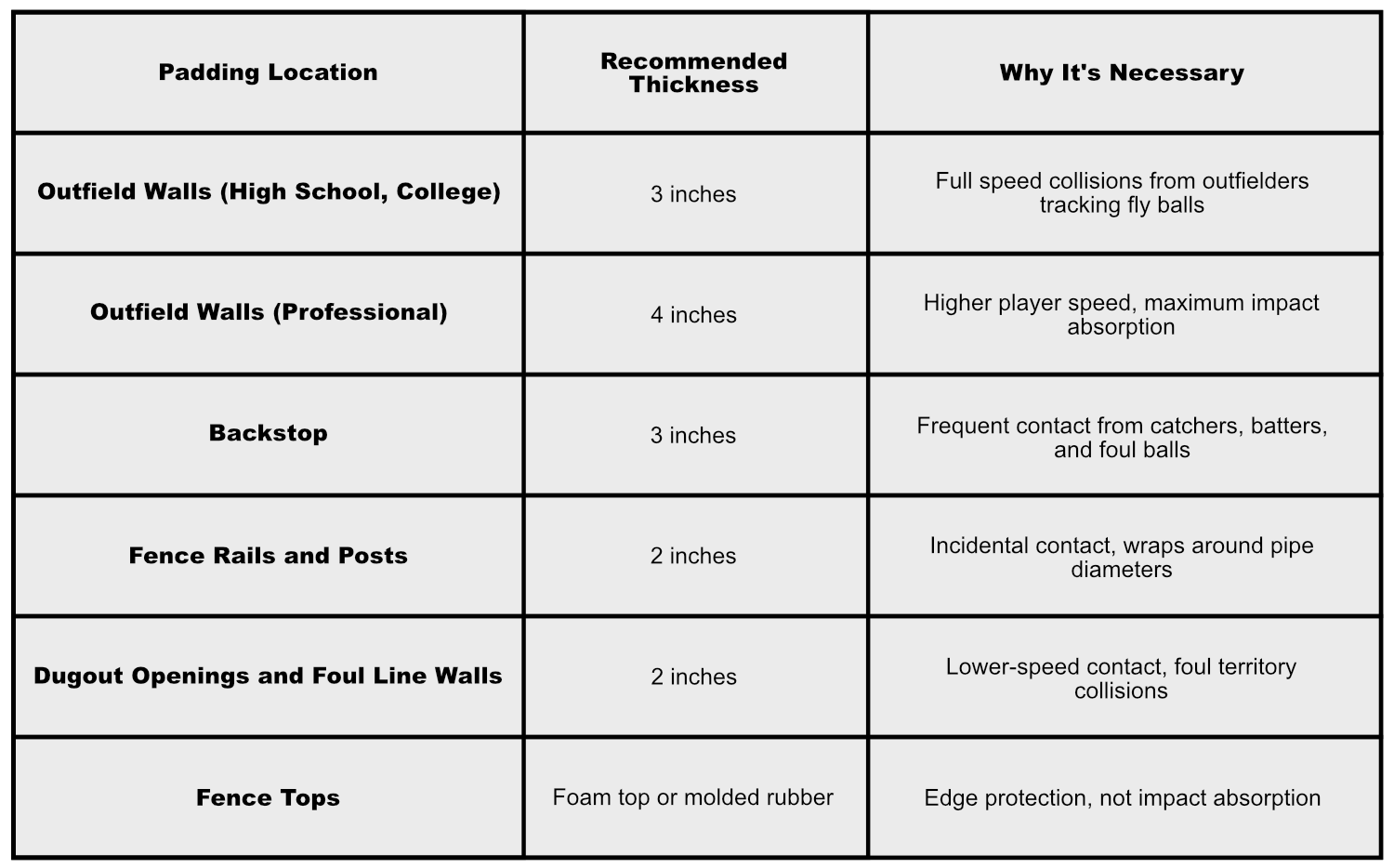
All our outdoor padding features closed-cell foam that won’t absorb water, which is essential for year-round exposure to rain, irrigation, and humidity. Encased in an 18 oz. UV-treated vinyl shell that resists fading and cracking, each pad will last through season after season of heavy sun exposure.
Outdoor Padding Mounting Systems
Below are how the padding attaches to what it’s being mounted on, depending on what it is that it’s being mounted to.
Solid walls (concrete, brick, wood)
Z-clip mounting systems allow outdoor wall padding to hang on the wall and be removed for maintenance or seasonal storage. They work by using clips that are anchored to the wall, and the pad hooks onto them. This is the most common system for outfield walls and backstops built from hard materials.
Chain-link fences
Bolt-through mounting uses stainless steel hardware that passes through the chain-link mesh and secures the fence padding on both sides. This creates a tight fit with no gaps between the pad and the fence. Bottom moisture vents in each pad allow condensation to escape and prevent mold buildup from the inside.
Round and square rails
Pre-slit rail pads wrap around the pipe and secure with bolt-through hardware or heavy-duty straps. The pre-slit design allows installation without disassembling the fence. Custom fence rail and post padding is manufactured to fit your exact rail diameter for a gap-free fit.
NCAA Rule 2.15 and How It May Affect You
Beginning January 1, 2027, NCAA Rule 2.15 requires that all sideline fences, home run fences, and backstops constructed of hard materials (wood, concrete, brick) be padded at every NCAA baseball and softball venue. The rule specifies that padding must start no higher than 1 foot off the ground and extend to the top of the structure or 6 feet, whichever is shorter. The minimum foam density is 2 inches meeting ASTM F2440 standards, though 3 inches is recommended for outfield walls and backstops.
This rule affects hundreds of collegiate programs that currently have unpadded or partially padded facilities. If your program needs to plan for compliance, our NCAA padding requirements guide covers the full rule text, a detailed cost breakdown, sponsor offset strategies, installation scheduling, and a step-by-step compliance checklist.
Even if your facility is not subject to NCAA rules, the 2.15 specifications are a strong benchmark for baseball wall padding at any level. The padding heights, foam densities, and coverage areas defined in the rule reflect current best practices for outfield wall padding, backstop protection, and perimeter fence safety at any level of competitive baseball or softball.
Custom Graphics and Branding
Every Valley Athletics stadium pad can be printed with team logos, school colors, sponsor graphics, and distance markers using UV-cured printing that is fused directly into the vinyl surface. For programs planning a full-field padding installation, sponsor logos on outfield wall pads can offset a significant portion of the project cost. This is especially relevant for NCAA programs budgeting for Rule 2.15 compliance, where logo pads turn a mandatory safety expense into a revenue opportunity for your baseball program.
Indoor Facilities
If your program trains or plays indoors, the same safety principles apply. Indoor batting cages, field houses, and multi-sport gyms have walls, columns, and beams that create hard contact points. Custom gym wall padding protect both athletes in these environments as well.
Planning Your Padding Layout
A padding project works best when you plan the full field at once, even if you install in phases. Here is how to approach it:
1. Walk the field and map every hard surface. Start at the backstop and work your way around the entire perimeter, including dugout openings, sideline walls, foul poles, and the full outfield fence. Note the material (concrete, wood, brick, chain-link with pipe rails) and height of each surface.
2. Measure rail diameters and wall heights. Record exact dimensions for every section. Rail pads are manufactured to fit specific pipe sizes, and wall pads are cut to match the height of each surface.
3. Prioritize by collision risk. Outfield walls and backstops are the highest priority. Fence rails and dugout openings come next. Fence tops and sideline structures complete the layout.
4. Choose your mounting system. Z-clips for solid walls, bolt-through for chain-link, pre-slit wraps for rails.
5. Plan graphics and branding. If sponsor logos will be included, finalize artwork before manufacturing so pads are printed as a single production run.
6. Request a quote. Valley Athletics has every pad to your exact field specifications. Get a Free Quote or call (866) 397-0497 to start your padding project.